Hainan Visa-Free in 2026: 30 Days in China Without a Visa
Quick answer
Citizens of 59 countries, including the United States, can enter China's Hainan province for up to 30 days without a visa, provided they hold an ordinary passport, enter through an open port in Hainan, and stay inside the province. It covers tourism, business, family visits, medical treatment, exhibitions, and sports events, but not work or study.
Citizens of 59 countries, the United States included, can enter China's Hainan province for up to 30 days with no visa at all.[1] You need an ordinary passport, an arrival at one of the island's open ports, and a willingness to stay inside the province. No consulate appointment, no onward third-country ticket.
That last sentence is doing a lot of work. China has spent two years opening its borders in ways that genuinely surprised people, but the openings are uneven, and which door is available depends entirely on the passport in your pocket. Hainan sits outside that system, on a rule of its own that predates the current wave.
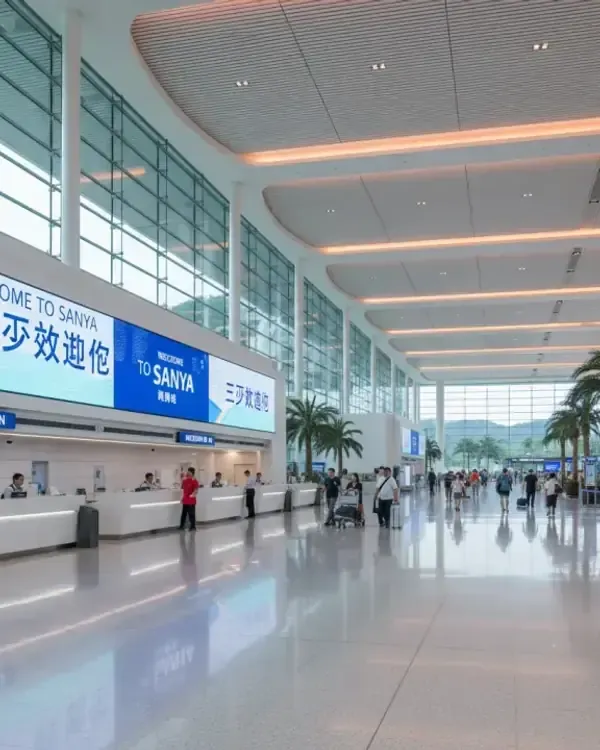
*Images are illustrative and may differ from actual lounges and airport facilities.
Three Different Ways Into China, and Only One of Them Covers Everyone
Start with the mainland picture, because it explains why Hainan matters. China's unilateral visa-free policy currently runs to the end of 2026 and grants stays of up to 30 days for business, tourism, family visits, transit, and exchanges. The list published by the Chinese Consulate General in Los Angeles names 44 countries plus Sweden, including France, Germany, Japan, South Korea, Australia, New Zealand, Brazil, Argentina, and Saudi Arabia. The United States is not on it.[3] Canada and the United Kingdom were added separately, from February 17, 2026, on the same 30-day terms and the same end date of December 31, 2026.[4]
The second door is the 240-hour visa-free transit, which we cover in detail in our China 240-hour transit guide. It is open to 55 nationalities, including Americans, and it now spans 24 provinces and municipalities. The catch is in the name: it is a transit policy. You have to show an interline ticket with a confirmed date and seat onward to a third country within those 240 hours.[5] Ten days is generous, but a round trip from New York to Shanghai and back does not qualify, because the return leg is not a third country.
Hainan is the third door, and it asks for none of that. The National Immigration Administration lists it among China's regional visa-free arrangements: 59 countries, ordinary passports, up to 30 days, entry through any open port in the province, and the stay confined to Hainan's administrative area.[1] Permitted purposes run wider than tourism alone and cover business, visits, family reunions, medical treatment, exhibitions, and sports competitions. Work and study are excluded.[1]
The 59-country list is broad, covering the United States, Canada, the United Kingdom, most of Europe, Russia, Brazil, Mexico, Argentina, Chile, Australia, New Zealand, Japan, South Korea, and most of Southeast Asia and the Gulf.[2] If your nationality already qualifies for mainland visa-free entry, Hainan adds nothing you need. If it does not, this is the difference between a passport stamp and a visa application.
The Details That Decide Whether Your Trip Works
Two constraints do the real filtering. The first is geographic: the permission is valid within the administrative region of Hainan province and nowhere else.[2] Hainan is an island roughly the size of Belgium, so this is less confining than it sounds, but it does mean you cannot use a Hainan entry as a side entrance to Beijing or Shanghai. The second is the clock. The provincial government's guidance states that the calculation of stay time starts from midnight on the day of entry, which is worth knowing if you are planning close to the limit.[2]
Ports of entry are published too. The airports are Haikou Meilan, Sanya Phoenix, and Qionghai Boao. The seaports are Yangpu, Haikou, Qinglan, Basuo, and Sanya.[2] Older write-ups still describe having to book the whole trip through a registered Hainan travel agency, which was how an earlier version of this policy worked. The immigration administration's current interpretation describes entry through any open port for these purposes without attaching that filing requirement.[1] Policies do get revised, so confirm with the nearest Chinese embassy or consulate before you book anything expensive.
What Actually Changed on December 18
Hainan launched island-wide independent customs operations on December 18, 2025. Reading the coverage at the time, you could be forgiven for expecting new paperwork at the airport. There is none. The change is about goods, not people.
The mechanism is described as freer access at the first line and regulated access at the second line. The first line is the boundary between Hainan and everywhere outside China's customs territory. The second line is the boundary between Hainan and the Chinese mainland, where normal customs controls apply.[7] Under the new arrangement the share of zero-tariff products rose from 21 percent to 74 percent, and the goods list expanded from around 1,900 items to more than 6,600.[6][7] Goods processed on the island with added value of 30 percent or more can then enter the mainland duty-free.[7]
For a visitor, the official line was refreshingly plain: travel to the island for business or tourism remains unchanged, with no additional documents required.[6] Your entry experience is the same as it was in 2024. The shops are what changed.
The Duty-Free Rules Are Now Written for Foreign Visitors Too
Hainan's offshore duty-free allowance is the largest of its kind anywhere, and it was rewritten in late 2025. The updated policy, jointly announced by the Ministry of Finance, the General Administration of Customs, and the State Taxation Administration, took effect on November 1, 2025.[8]
The headline number is 100,000 yuan per person per calendar year, with no cap on the number of transactions.[8] Categories went from 45 to 47, picking up pet supplies, portable musical instruments, mini drones, and small appliances, while domestic Chinese products such as clothing, footwear, ceramics, scarves, coffee, and tea can now be sold in duty-free shops with value-added and consumption taxes refunded or exempted.[8] The minimum age rose from 16 to 18.[8]
The change that matters most from abroad is the eligibility one. Travellers departing Hainan for overseas destinations now qualify for the offshore duty-free policy, which was previously oriented around passengers heading to the mainland.[8] An international visitor flying home out of Haikou or Sanya can use the allowance on the way out. As with the real cost of eating at the airport, the money is in knowing the rule rather than hunting for a discount.
Getting There Is the Genuine Constraint
Visa policy is the easy part of a Hainan trip. Flights are harder. The island's route network is heavily weighted toward domestic and regional traffic, so most travellers from North America or Europe will connect through a mainland or Asian hub rather than fly direct.
One route is worth knowing about for what it signals. In December 2025 Sanya gained a weekly service to Prague, flight DV481, operated by Kazakhstan's SCAT Airlines with a Boeing 737 MAX 9.[9] It is China's first passenger route flown under seventh-freedom rights, which allow an airline to operate between two foreign countries without touching its own, and officials described it as the highest level of openness in China's civil aviation sector.[9] One weekly flight changes nobody's itinerary by itself, but the precedent is the kind of permission that makes further European and Central Asian routes possible.
In the meantime, the practical routings run through hubs we have already mapped: Shanghai Pudong, covered in our Shanghai lounge guide, plus Beijing Capital, Guangzhou, Hong Kong, and Singapore. Note that transiting the mainland to reach Hainan is its own question, since a mainland connection may need the 240-hour transit permission or a visa depending on your nationality and how the ticket is written.
Lounges at Haikou and Sanya
Both island gateways are better served than their passenger numbers suggest, largely because Chinese airports tend to have several contracted lounges rather than one flagship.
At Haikou Meilan, Priority Pass lists lounges across both terminals. In Terminal 1 there is an Easyflying Lounge landside in the domestic departures hall, open 05:30 to 22:00, a second Easyflying Lounge airside on the second floor opposite Gate 19 from 06:00 to 22:00, and a First Class Lounge airside on the third floor near Gate 13. Terminal 2 has the Fortune Wings Lounge on the fourth floor near Gate 47 and a China Southern lounge open 06:00 to 23:00, reached by the lift beside Gate 32.[10]
At Sanya Phoenix, the First Class Lounge sits in Terminal 1 on the second floor opposite Gate 208, open 07:00 to 22:30, and China Southern's lounge is in Terminal 2 from 05:00 until its last departure, up the lift opposite Gate 217.[11] Both are for departing passengers only and both publish a maximum stay of two hours, with access subject to space.[11] The Terminal 2 lounge offers complimentary massage chairs, and alcohol there is limited to beer.[11]
One caveat on the landside Easyflying Lounge at Haikou: a room before security is useful, but it leaves security and immigration still ahead of you, so budget the time. If you are weighing whether a membership pays for itself here, our comparison of Priority Pass, LoungeKey and DragonPass and the roundup of cards that include lounge access are the places to start. DragonPass has unusually deep coverage across mainland Chinese airports, which matters if your routing includes a long mainland connection.
Before You Book
- Check your nationality against the right list. If you already have mainland visa-free access, Hainan's rule is redundant. If you do not, it is the only 30-day option that needs no onward third-country ticket.[3][5]
- Do not plan a mainland side trip on this permission. The stay is valid inside Hainan province only.[2]
- Land at a listed port. Haikou Meilan, Sanya Phoenix, and Qionghai Boao are the published airports.[2]
- Confirm before you fly. The unilateral policy for most European countries, Canada, and the UK is written to expire on December 31, 2026, and dated policies get renewed, changed, or allowed to lapse.[3][4]
- Sort connectivity in advance. Chinese payment apps, maps, and messaging all assume a working data connection from the moment you land, which is a strong argument for arranging an eSIM before departure. Our China travel guide covers the payments side in more detail.
Hainan usually gets sold as China's tropical resort island, which buries the genuinely interesting part. An island with its own customs boundary, its own duty-free allowance, its own aviation rights, and its own visa policy is an unusual thing, and right now it is the most accessible piece of China for a large group of travellers who would otherwise be filling in a visa form.
Information is reviewed periodically. Visa policies, entry requirements, duty-free allowances, and lounge access rules change frequently. Always verify current requirements with the Chinese embassy or consulate for your country, the National Immigration Administration, and your lounge programme before you travel.
Frequently asked questions
- Can Americans go to Hainan without a visa?
- Yes. The United States is one of 59 countries covered by Hainan's 30-day visa-free entry policy, which the National Immigration Administration lists among China's regional visa-free arrangements. This matters because the United States is not on China's separate unilateral visa-free list for the mainland, so for American passport holders Hainan is the one province reachable on a full 30-day stay with no visa and no onward third-country ticket.
- How long can I stay in Hainan visa-free?
- Up to 30 days. The provincial government's published guidance states that the calculation of stay time starts from midnight on the day of entry. The permission applies only within the administrative region of Hainan province, so it does not let you continue on to Beijing, Shanghai, or anywhere else on the mainland without a separate visa or a different visa-free arrangement.
- Which airports can I use for Hainan visa-free entry?
- Hainan's published ports of entry for the policy are Haikou Meilan International Airport, Sanya Phoenix International Airport, and Qionghai Boao Airport, along with the seaports at Yangpu, Haikou, Qinglan, Basuo, and Sanya. Haikou Meilan and Sanya Phoenix carry the overwhelming majority of international passenger traffic and are also the two Hainan ports listed under China's 240-hour visa-free transit policy.
- Did the Hainan Free Trade Port customs launch change entry rules for tourists?
- No. Hainan launched island-wide independent customs operations on December 18, 2025, but the change applies to goods rather than people. Officials stated that travel to the island for business or tourism remains unchanged and no additional documents are required. What did change is the shopping side, including a wider range of zero-tariff goods and a revised offshore duty-free policy.
- How much can I buy duty-free in Hainan?
- The offshore duty-free policy allows up to 100,000 yuan per person per calendar year with no cap on the number of transactions. Updated rules jointly announced by the Ministry of Finance, the General Administration of Customs, and the State Taxation Administration took effect on November 1, 2025, raising the minimum age from 16 to 18, expanding the goods list from 45 to 47 categories, and extending eligibility to travellers departing Hainan for overseas destinations.
Sources
Factual claims in this article are sourced from the operator, airline, or airport authority pages below. AirportLounge.com does not republish copyrighted content from these sources; we link to them so readers can verify.
- [1]
- [2]
- [3]
- [4]
- [5]
- [6]
- [7]
- [8]
- [9]
- [10]
- [11]