EU Entry/Exit System (EES) in 2026: What U.S. and Canadian Travelers Face at the Border Now
Quick answer
The EU Entry/Exit System (EES) replaces passport stamps with biometric registration for non-EU short-stay travelers crossing the external borders of the Schengen countries. On your first crossing you provide fingerprints and a facial image at a kiosk or officer's desk, and your record is reused on later trips within the registration window.
The European Union's Entry/Exit System (EES) became fully operational on April 10, 2026, ending the era of passport stamps for non-EU short-stay visitors and replacing them with a biometric border system across all 29 Schengen countries. On your first arrival you provide four fingerprints and a live facial image at a kiosk or officer's desk, your data is stored for three years, and subsequent crossings during that window are a quicker identity check. The first six weeks of operation have produced two to four hour queues at the busiest hubs, including Paris Charles de Gaulle, Madrid Barajas, and Barcelona El Prat. Plan extra time, know which lane to use, and consider a connection through a quieter Schengen entry point.
For travelers flying into Europe after the April 10 switchover, the difference between a smooth crossing and a missed connection mostly comes down to which airport you pick. EES is not optional and it is not going away, but it is also less daunting than the early headlines suggested once you understand what happens at the kiosk.
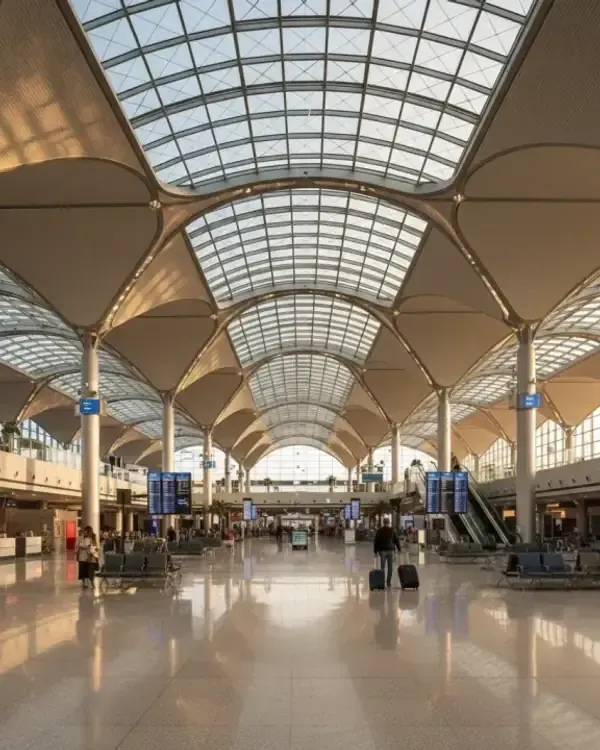
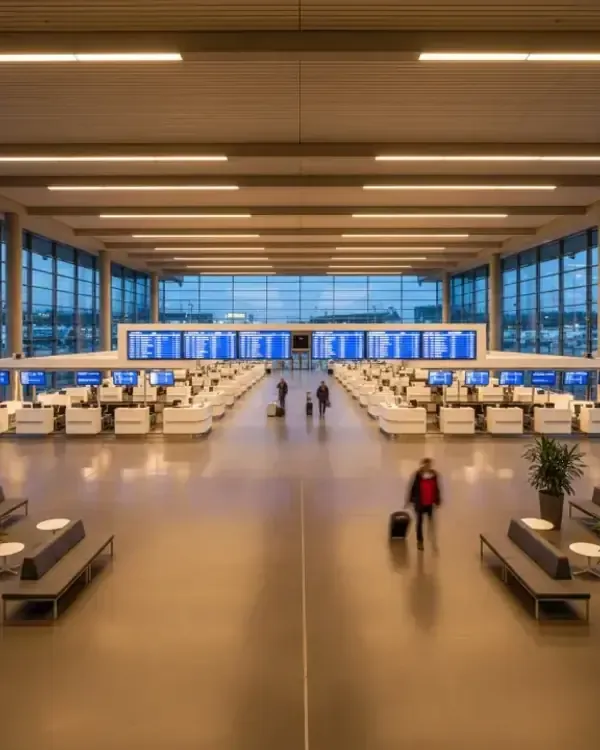
*Images are illustrative and may differ from actual airport facilities. Border procedures, lane assignments, and queue conditions change frequently. Always verify the latest information directly with your airline, the airport authority, or the European Commission before travel.
What EES Actually Is
The Entry/Exit System is a centralized EU database that records every external border crossing made by a non-EU national for a short stay of up to 90 days in any 180-day period. It is operated by eu-LISA, the EU agency for large-scale IT systems, and replaces the old practice of inking a passport stamp on entry and exit. Instead of a stamp, the system stores your name, travel document details, the date and place of every entry and exit, four fingerprints (typically from one hand), and a live facial photograph. The official scope and purpose is published on the European Commission's Entry/Exit System policy page.
EES applies at the external borders of the 29 Schengen countries, which includes most of the EU plus Iceland, Liechtenstein, Norway, and Switzerland. It does not apply at internal Schengen borders, because there are no border checks between Schengen states anyway. It also does not apply to Ireland or to the UK, since neither is in Schengen.
Who EES Applies To, and Who Is Exempt
If you hold a U.S., Canadian, Australian, Japanese, or any other non-EU passport and you are entering the Schengen Area for a short stay of up to 90 days, EES applies to you. That includes tourists, business travelers, conference attendees, students on short courses, and anyone visiting friends or family. It applies whether you fly in, drive in from a non-Schengen country, or arrive by sea.
Exemptions are narrow. EU, EEA (Iceland, Liechtenstein, Norway), and Swiss citizens are not in scope, because they have the right of free movement. Non-EU nationals who hold a valid long-stay visa, a residence permit, or a residence card for a Schengen country are also exempt, because they are not on a short-stay regime. Diplomatic and certain official passport holders have separate rules.
One quirk worth noting: if you are from a visa-required country and you already gave fingerprints during your Schengen visa application, the EES kiosk will not redo your fingerprints, because they are already in the EU Visa Information System. You will still go through the facial photo step. For more on the wider European travel rule changes coming next, our ETIAS Europe 2026 guide covers the separate travel authorization launching at the end of the year.
What Happens at the Kiosk on Your First Trip
The first time you arrive at a Schengen external border after April 10, 2026, your biometric data is registered. At most major airports this happens at a self-service kiosk before you reach the border officer, with staff on hand to help. The process has four steps:
- Scan the chip page of your passport on the reader.
- Look into a camera for a live facial image.
- Place four fingers from one hand on the fingerprint scanner.
- Proceed to a border officer who reviews the record and stamps you in electronically, no ink involved.
The whole process is supposed to take one to two minutes per person once the kiosk is working. In practice the April and early May 2026 queues built up because too few kiosks were installed for the non-EU passenger volume, and some airports duplicated biometrics already captured. The European Commission has invoked the regulation's flexibility clause, which lets member states partially suspend EES checks for up to 90 days, with a possible 60-day extension, during peak periods.
Subsequent Trips Inside the Three-Year Window
The biometric record you create on your first post-April 10 entry is good for three years. Within that window, when you fly back into Schengen, you typically only need one biometric check (either a facial scan or a fingerprint, not both) to verify it is the same person against the stored record. Your entry and exit are then logged automatically, and the system updates the running count of days used toward your 90-in-180 short-stay limit.
That three-year clock resets if your passport changes, because the record is tied to the travel document. If you renew your passport during the three-year window, your next entry on the new passport is treated as a first entry and you re-register your biometrics. Plan for this if your passport is close to expiry.
Where the Queues Have Been Worst
Reports from the first six weeks point to a handful of airports that have struggled. Paris CDG has drawn the most consistent complaints, with non-EU travelers funneled into manual lanes that were not built for the volume. Madrid Barajas and Barcelona El Prat both clocked three-hour waits in the first week. Amsterdam Schiphol and Frankfurt have had intermittent delays, usually tied to kiosk outages. The London to Paris Eurostar terminus at Gare du Nord has also been congested, because EES applies before boarding rather than on arrival.
Quieter Schengen entry points have generally been fine. Smaller airports like Cologne Bonn, Krakow, Helsinki, Porto, and Lyon have had short waits even during peak afternoon banks. If you have routing flexibility, transiting through one of these and connecting onward inside Schengen is a useful workaround, because once you are biometrically logged in at the first port of entry, internal Schengen flights have no border control.
Which Lane Should You Use at the Airport
The signage has been inconsistent in the first weeks, but the rule of thumb is simple. EU/EEA/Swiss passport holders go through the "EU/EEA/CH" lane, which usually has eGates and no EES involvement. Non-EU short-stay travelers go through the "All Passports" lane, which is where the EES kiosks live, alongside the manual desks. Some airports are also routing diplomatic and crew passports separately.
At a few large airports, officers have started selectively letting non-EU passengers, like UK, U.S., Canadian, and Australian travelers, use the EU eGate lanes when manual queues blow up, but this is a flexibility measure rather than the published rule. Do not assume you can use the EU lane unless an officer waves you over.
How to Time Your Trip in 2026
A few practical adjustments for any Schengen trip booked in summer or fall 2026:
- Add a two-hour buffer to a connection that is your first Schengen entry since April 10, 2026.
- If onward timing is tight, prefer a non-Schengen to non-Schengen routing through London Heathrow, Istanbul, or a Gulf hub, since a transit that stays outside Schengen does not touch EES.
- Carry a printed itinerary, return ticket evidence, and proof of accommodation. If a kiosk rejects your passport, the manual officer review moves faster with paperwork ready.
- Charge your phone before landing. Some airports run pilot apps for pre-registration where you can fill in passport data ahead of time.
- If you have a status or premium lane benefit, use it. Priority immigration usually bypasses both the manual desk and the EES backlog.
Lounge Strategy Around the Border
Most lounges live inside Schengen, after immigration. If you connect onward to a non-Schengen flight to the UK, the Gulf, or Asia, EES does not re-engage at the connection point, so the departure side queue is the one to plan around during peak banks. If your card gives you lounge access, the broader premium credit card lounges, including Centurion, Priority Pass, LoungeKey, and DragonPass facilities at hubs like CDG, AMS, and FCO, give you a calm place to ride out a slow border. Our piece on when to check in and how premium cards help you skip the crowds covers the timing math.
EES vs ETIAS: Two Different Things
Travelers regularly mix these up. EES is what happens at the border, in real time, and applies to everyone arriving for a short stay. ETIAS is a separate online travel authorization for visa-exempt nationalities, similar to the U.S. ESTA, and you apply for it before you fly. ETIAS is currently expected to launch in late 2026. You will eventually need both: ETIAS approved before boarding, EES biometrics at the border on arrival. For the latest see our ETIAS guide, and for the UK the separate UK ETA guide.
Privacy and Data Retention
The EES record is stored for three years after your last entry, or five years if you overstay the 90-in-180 rule. Data is accessible to border, immigration, and certain law enforcement authorities under rules set out in the EES regulation, and you can request access to your own record. For the official traveler page see travel-europe.europa.eu/ees, and the Lufthansa Schengen entry summary is a clear airline-side walkthrough.
Bottom Line for U.S. and Canadian Travelers
EES is now a normal part of every Schengen trip. Your first crossing after April 10, 2026 takes a few extra minutes for the kiosk, your next crossings inside the three-year window are quicker than the old stamp routine, and the new biometric step is unavoidable. The two things you can control are which airport you fly into and how much buffer you build into your connection. Pick a less-congested first port of entry where possible, schedule a generous connection window through summer 2026, and treat the kiosk step as part of your normal arrivals routine, the way you already do with U.S. CBP kiosks coming home. If you travel through Schengen more than once a year, the system will quickly feel like a non-event.
Information is reviewed periodically. Border procedures, kiosk availability, and queue conditions change frequently and vary by airport. Always verify the latest guidance with the European Commission, your airline, and the airport authority before you travel.
Frequently asked questions
- Do US and Canadian travelers need to do anything before flying?
- There is no advance form to complete for EES. The registration happens at the border on arrival. You should still budget extra time, since first-time biometric registration adds minutes per traveler and queues can build at busy hubs.
- Is EES the same as ETIAS?
- No. EES is the biometric entry and exit registration done at the border. ETIAS is a separate pre-travel authorization you apply for online before your trip. They are related parts of the same border modernization but are not the same step.
- Do I have to give fingerprints every time?
- The full biometric capture happens on your first crossing and is stored for a set period. On later trips within that window the check is faster because your record already exists, though you may still verify your identity at the border.
Sources
Factual claims in this article are sourced from the operator, airline, or airport authority pages below. AirportLounge.com does not republish copyrighted content from these sources; we link to them so readers can verify.
- [1]
- [2]Entry/Exit System (Wikipedia)Accessed